Search This Blog

Wednesday, 21 November 2012

Ted Spagna


Ted Spagna was a truly fascinating photographer who took photos of people and animals in timed intervals. Sometimes the intervals were every fifteen minutes, or every night. By doing this, Spagna not only created visually engaging photosets, but helped scientists to study patterns of activity during sleep and find evidence of the different stages of sleep (ie. REM and NREM sleep). I completely love the idea of documentative photography which shows a progression of activity over a pro-longed period of time. I'm attracted to the potential to learn about the things we're unaware of during sleep. Spagna would install a camera over the consenting person or couple's bed and set it to a timer and leave it untouched for the duration of the study. In this way the people being photographed could forget about the presence of the camera and behave naturally.

One particular project which piqued my interest was Spagna's study of a couple over the course of a few months. At the beginning of the project the couple slept close together and showed signs of affection in their body language and movements, but as the weeks and months wore on, they began to sleep further apart and with stiffer posture and movements until they eventually seperated. I really like the fact that a series of still images told the intimate story of a relationship from an objective perspective. The photographer played no part in the pictures other than to install the camera; the observation was completely unbiased and covert. It's simple and understated yet holds so much information.

Having pictured people sleeping for years, Spagna branched out to animals in captivity and developed animal-proof cameras after several were smashed by irritated creatures. Sadly I haven't been able to track down any of these images on the internet, but I've read that Spagna used long exposures when capturing the animals creating ghostly images that showed the history of movement. He even photographed sleeping flamingos which I would love to see, I can imagine the colours and movement of a flock of large birds would look fantastic when taken with a long exposure.

Here are some websites with more information on Ted Spagna:
People.com
TedSpagna.com


Tuesday, 20 November 2012

The Pixel

Pixels, a term coined in 1965 and short for picture elements, are the smallest components of a digital image. They can only be one colour, but next to each other in their thousands or millions will blend to make a smooth image full of tones and shapes. The higher the resolution a digital image is, the more pixels are displayed and the smoother the image appears. "Bits" refer to the number of colours a pixel can possibly be. For example, 8-bit colour (ie. 2 to the power of 8) will display 256 colours, 16-bit colour (also called Highcolour; 24-bit colour's known as Truecolour) will display 65,536 colours and so on. The higher the number, the better the picture quality. 
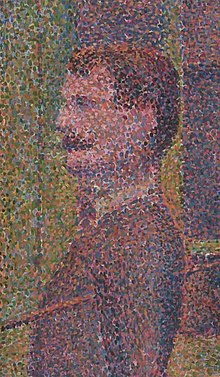
Close up of Seurat's Circus Sideshow

Some artists have created paintings using techniques which almost imitate the aesthetic of a pixelised image. They paint their subjects in a deconstructed fashion, in lots of tiny individual components rather than blending the colours into each other. Georges Seurat, for example, was very fond of using pointilism in his paintings. The singular points of colour in their thousands make his work look grainy and almost pixelised like a digital image with a low resolution. 


Circus Sideshow by Georges Seurat (1889)

While Seurat wasn't aware of the similarity between his work and the pixels of a modern digital image, there are quite a few artists today who deliberately emulate the pixelated aesthetic in their work. 

Chuck Close is one such artist. While he is capable of creating photorealistic images, he chooses to break his images down into hundreds of small componentes. Within each square he uses four or five colours eventually accomplishing a vibrant and unusual aesthetic in his pictures. The over effect makes me think of looking at a person through patterned glass or through the surface of disturbed water. It makes his portraits more interesting to look at by creating a sense of mystery or censorship around the subjects. It piques the viewer's interest in the person being slightly hidden from view by Close's unique style of painting.

John Hinde and Martin Parr


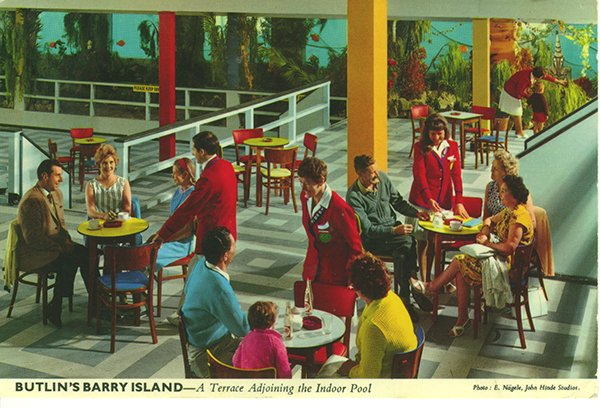
John Hinde was an English photographer, probably most famous for his iconagraphic postcards, particularly of the Butlin's Holiday Camps. He was most active in the 60s, having established his own photography comapany, John Hinde Ltd, and became known for his photographs of the Irish landscape around Dublin. At the time, most postcards were printed in black and white as it was thought this better captured the romantic landscape of Ireland. Hinde, however, favoured colour photos and wanted to capture the vibrancy of the Irish countryside. He would plan his photographs meticulously, often adding things to the scenery or hiding them with rhododendron bushes in order to get the ideal composition. He would spend entire days setting up a photograph to his liking. As well as painstakingly planning a photograph, Hinde would edit the colours in the image to enhance the energy of a scene. This is evident in most of his photographs; the colours seem to burst out at the viewer, forcing their attention to the activity in the scenery. The postcard above, for example, "Butlin's Barry Island", highlights the postive interaction between the staff and holiday-makers with his use of brightly coloured clothing and the close proximity of the subjects.
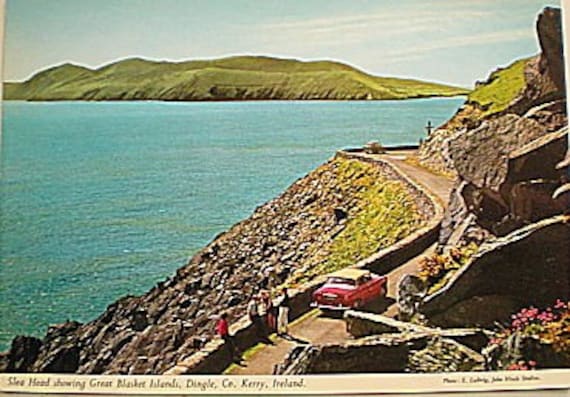
The two postcards above, both taken in Ireland, to me, have a wonderfully tacky fifties/sixties look to them because of the enhanced colours and calculated composition. Hinde had a strict formula when it came to composing a photograph which makes his work easily recognisable. Nowadays photographers generally like to make their photographs looks more spontaneous and open; there aren't as many conventions and rules to follow. However, many artists and photographers have been inspired by Hinde's iconic work.

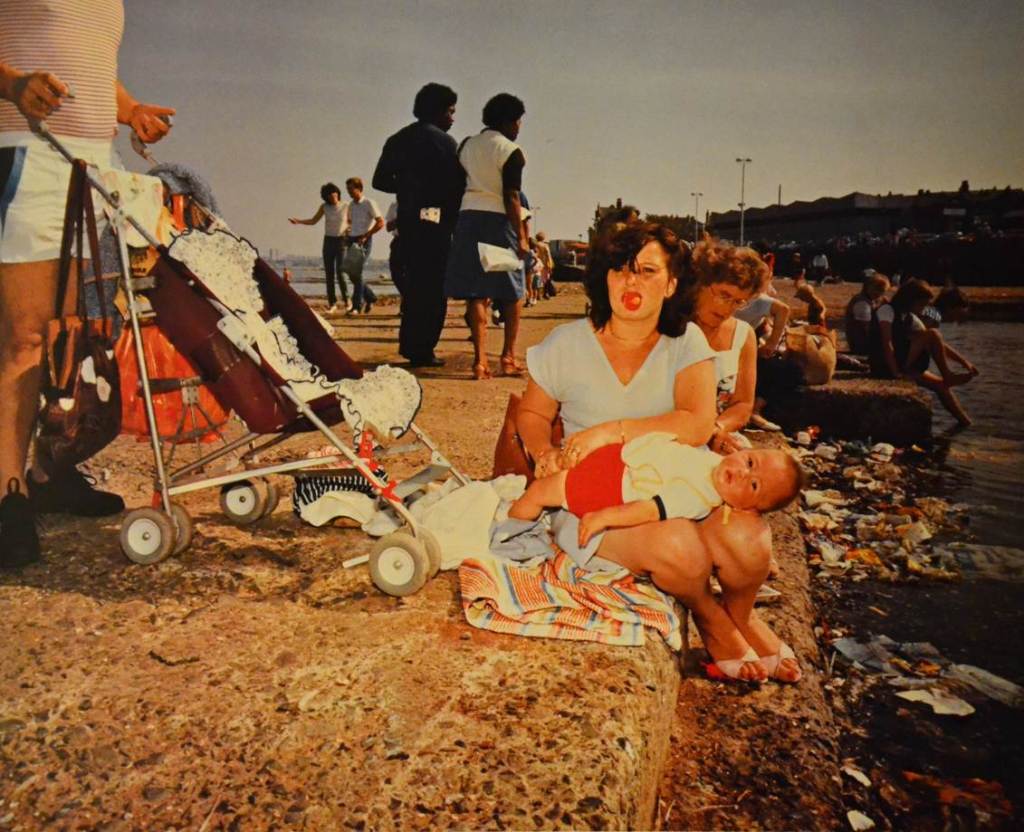
One of these photographers is Martin Parr whose photographs exposing the tacky-ness of British culture have the same empahisis on the colour and activity in a scene.

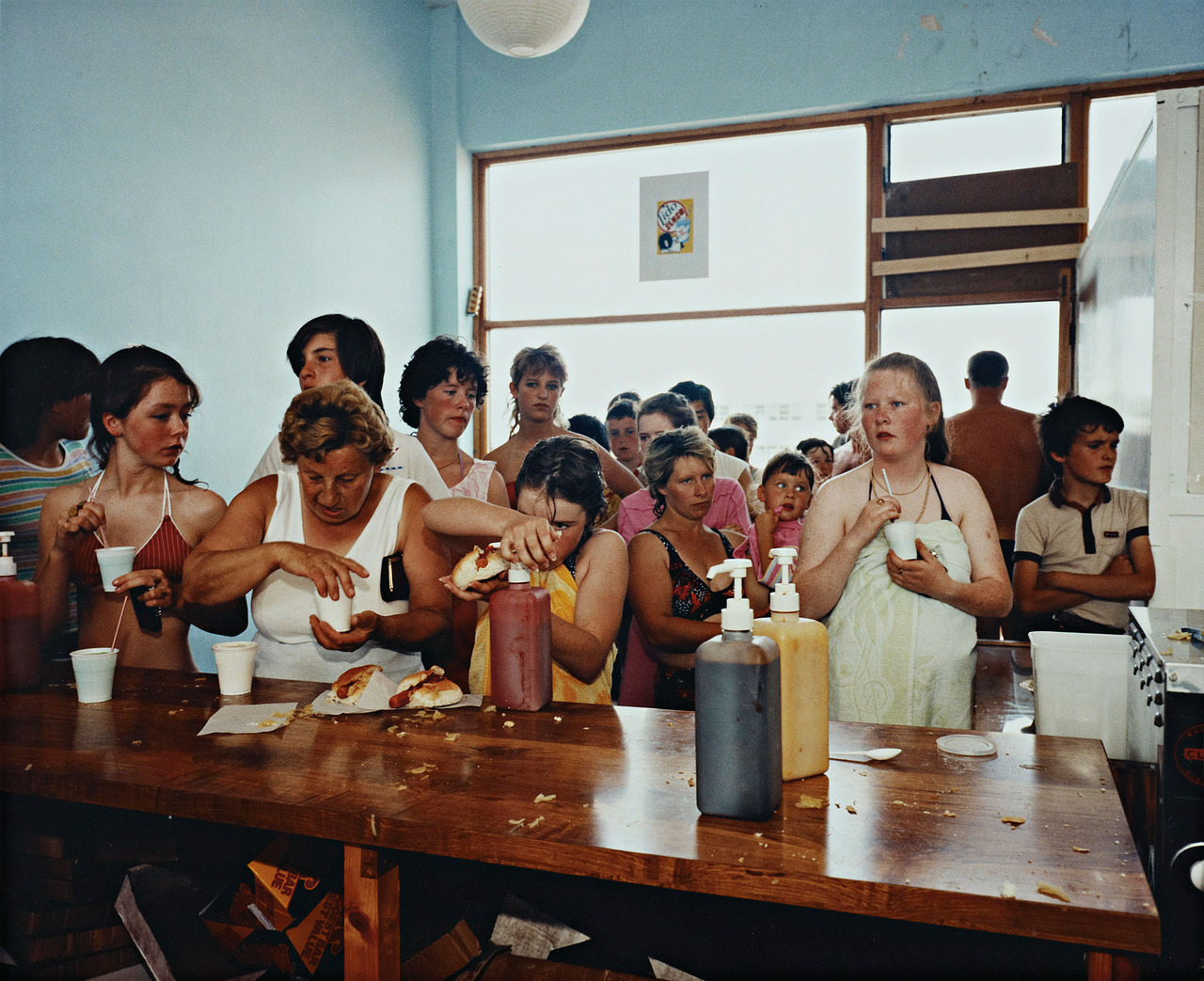
This photograph is one of a collection published in 1986 titles Last Resort: Photographs of New Brighton. The collection is full of photos documenting British holiday-makersmaking the most of the English summer. It reveals the awfully tacky side British culture and its desperate bid to take advantage of the short summers we have. As soon as the sun comes out people will want to sunbathe, take their children to parks and beaches and wear as little clothing as decently possible. Unlike Hinde, Parr doesn't choreograph his photos but takes a documentative approach to photography. It makes his photos feel more intrusive and gritty than Hinde's composed scenes. Parr wanted to document and highlight the habits of ordinary British people. 


When I look at the picture above I can imagine the clammy feeling of being crammed in a badly conditioned diner with irritable parents and hyper children surrounding me. The photograph perfectly captures the situation so that I can empathise with the people inside it. The image is also particularly effective because of the claustrophobic environment with so many people inside; it looks busy and you can sense the impatience of the people queuing towards the back. I also love it because it's so quintissentially British; there's fast food, tea, rosy faces and queueing!


Friday, 16 November 2012

More stalking by me


So I went on another mission to take stalker-ish pictures. This time I planned out the pictures beforehand and focused on a specific person and their belongings. I wanted to accentuate the theme of obsession with a particular person so I used my tablet to draw over the silhouettes of her body and her belongings. I put the numbers in the 800/900s to exaggerate the amount this person has been stalked by the photographer and make the obsession clear.
 If I presented this in an exhibition, I would have "stolen" items on display with the photos and notes about the stalker's feelings for the person.

Pink around the legs and a red border to suggest infatuation with the subject.


It was a happy coincidence that Chedira's work has a voyeuristic element in it.
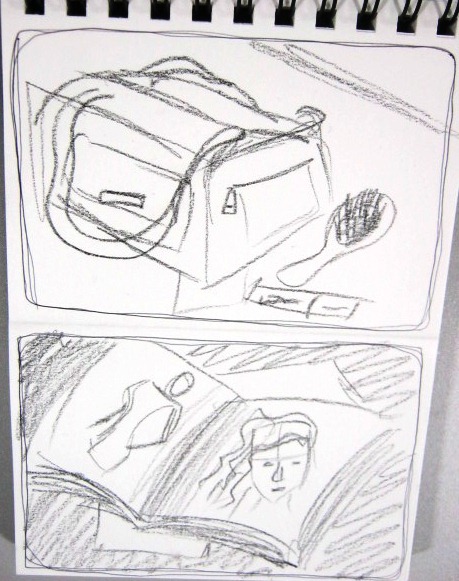
You can find the storyboard created for these photos here.

Storyboard


 These keyframes are the composition plans for a photoshoot in which I will focus on a particular person and photograph them as well as their belongings. I kept the illustrations simple as I know that when it comes to taking the pictures there might be reasons for changing certain aspects of the pictures. However, the subjects and distance will stay the same.

Wednesday, 14 November 2012

My first photos

This photo was inspired by the ruthless invasion of privacy by the media whenever something sensational happens to a person. The headline about a rape victim wasn't deliberately chosen to be in the shot, but really enhances the sense of the uncomfortable viewing of a sensitive subject, especially as it's placed right next to an article about a pulp reality TV show.

 I was given a camera and walked around school with a friend taking pictures to look as if we had been stalking people. Here are some of the results:

I really like this particular photo because of the reflections in the glass obscuring the person behind it. We experimented with revealing the photographer in the reflection but weren't able to get any effective results. I want to set up a photo shoot involving strategically placed reflective surfaces in order to get a good photo of both the subject and the photographer.


 Our goal was to make the images seem as if they were taken without the subject knowing. We did this by putting obstacles between the camera and the person in shot and taking the photos from a distance. For some of the photos we asked peole to pose, but a few are of genuinely unsuspecting people. I'd quite like to take this further by selecting a few photos to draw onto and create borders like Miroslav Tichý did with his favourite photos.
The black and white photos above were taken without the man knowing. Indi pretended to pose for pictures while standing in front of him so that I could take pictures facing his direction without him being suspicious. I decided to keep Indi in the shots as a clue to how the pictures were taken, as well as to keep the sense of amateur photography. With the pictures seeming spontaneous and surreptitiously taken, the sense that there is no relationship between the subject and the photographer is maintained and it looks like more of a violation of the subject's privacy. 
The set of images below were posed by myself, Indi, and someone we met (and gotten permission to photograph) in the school library. I prefer the images in which most of the person's body and face are obscured because it creates an air of mystery about the picture. The viewer is more likely to question who this person is and why they're being photographed if they can't see all of them. 


Tuesday, 13 November 2012

MIROSLAV TICHÝ

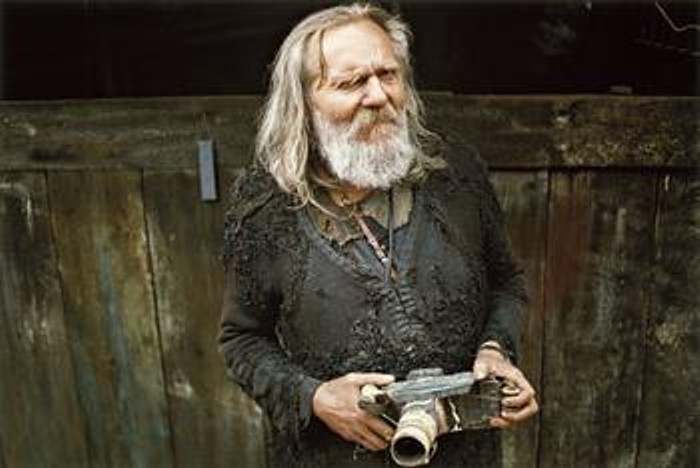
Miroslav Tichý was an introverted amateur photographer from the Czech Republic who bulit his own cameras and took thousands of pictures of the women in the town of Kyjov. Despite his reputation as an unkempt voyeur, Tichý had actually studied at the Academy of Fine Arts in Prague and was a talented painter in the modernist mode. However, in 1948 he was forced to paint in the socialist mode after the communist takeover of Czechoslovakia so he quit school and moved back in with his parents. He continued to draw and paint for himself, then in the sixties began to wander through his town taking pictures with a home-made camera. In 1972, his studio was taken from him following the Soviet takeover of the country and he abandoned painting and focused solely on his home-made photographs. He would take about ninety pictures a day of women in various places around the town: walking down the street; sunbathing; at the swimming pool (through a fence- he'd been banned); shopping. Some women would smile and strike a pose if they saw him, thinking he was a crazy homeless man with a toy camera.  Because of his refusal to conform to societal norms, he was considered a dissident (threat) by the government and was hidden in psychiatric hospitals during national holidays when the streets would be busy. 


All of his photographs were developed in his home and kept carelessy around the house. He would draw over some photos to accentuate the forms within the images and cut them to improve composition. Only the interest of his friend  Roman Buxbaum ensured the preservation and eventual exhibition of his photographs, despite Tichý's disinterest in publishing the photos. He took them purely for his own enjoyment; they were meant to be personal. 
All of his photos are flawed with imperfections such as under/over-exposure, blurry focus and spots, but as Tichý said himself, "The flaws are part of it.  That's the poetry."

He built his cameras from scratch in an ingenious manner, using materials such plywood, plexiglass, asphalt, thread spools and dressmaker's elastic. This Tumblr post by IDoStuff  explains Tichý's process in an entertaining yet informative way.

I like that all the photographs he took seem private and spontaneous. You can tell that most of the women are unaware of his presence, or unconcerned by it, making the poses natural and more personal. In the photograph of the woman above, you can see the fence he was stood behind, making the subject more remote but the photograph itself more ilicit. You can get a real sense that Tichý had no connection to these women and that he's an uninvited observer of their day-to-day lives. The imperfections in the photos are a clue to the involvement of the photographer with the subject; they are clearly unprofessional and home-developed with hand drawn borders on card. The photos were never meant to be made public but are the product of an obsession.