Search This Blog

Tuesday, 27 November 2012

Cat Watching

I'm not going to pretend that I'm not a Crazy Cat Lady waiting to happen, because I really am. I love cats to bits. I think they're better than both sliced bread and microwavable pizza. So when I work my volunteer shift at an animal shelter every saturday morning I tend to get carried away staring at all the adorable bundles of fluff that are unfortunate enough to need to be taken in, and take hundreds of pictures so that I can show my friends and family. 
All the pictures shown in this post are my own, taken with a phone, and don't even come close to indicating the true volume of pictures I have of cats and other animals. The ones here are literally half of what I happened to have on my phone at the time of writing this. 
Upon realising the sad truth of my obsession, I felt like I understood how Miroslav Tichý felt about photographing all those hundreds of women. I really just want to document every cat which comes to the shelter, partly so that I have a record of them, but also because some of them are so gorgeous it melts my heart. And if weren't for the fact that I can store the images digitally I would be less inclined to take so many pictures, but the availabilty of digital cameras, computers and hard drives allows me to indulge myself. I'm sure that if I had to develop each photograph and physically store them like Tichy did with his hoard of photos, I wouldn't bother to take so many pictures. But as it is, it's just so easy to keep taking an embarrassing amount of pictures so that I can look at them whenever the mood takes me. 
It makes me think that being able to digitally store images probably encourages voyeuristic behaviour in people because it's easier to justify or brush off as a quirk of character. I know plenty of people who have folders and folders on their computers filled with pictures of celebrities they admire and they think nothing of it because the images are so readily available to them. The fact that it's a digital collection provides a sense of detatchment which prevents the person feeling like a stalker; there's something about keeping physical copies of somebody's image which feels much more personal. Thanks to Google, anyone can type anything into the search bar and find masses of information and pictures ready to be used as the person wishes. And while this is brilliant for learning and communicating with people, it can also be grossly misused. 
For example, I am publishing my photos of these cats on the internet without their consent and knowledge, which is deemed permissable because they don't even know what a computer is, but if I were to post up pictures of people without their consent it would a breach of their right to privacy. I would also feel extremely uncomfortble photographing people without their knowledge because I know it's unethical. (See Shizuka Yokomizo who found an interesting way around this which I love.) But I think that photographing animals gives you the freedom to stare to your hearts content without any ethical issues- as long as you don't disturb/mistreat the animals, that is.

Wednesday, 21 November 2012

Airbrushed Pigeons in Venice


Last summer artists Julian Charrière and Julius von Bismarck collaborated to airbrush 35 pigeons with an unnatural rainbow of colours. They managed this by building and installing a pigeon trap which acted rather like a car wash conveyer belt, only with paint. Pigeons would go in one end black and grey only to emerge on the other side in colours ranging from electric blue to sunset red. Although the birds looked gorgeous and Charrière claimed that the project was an attempt to inspire more respect for the birds dubbed "rats with wings", I can't help but feel that it was a tiny bit unethical to trap birds and spray some sort of paint onto them. The artists haven't even specified the paint used or the harm this could cause to the birds' feathers and skin. Unsurprisingly, many people have been critical of the treatment of the birds with many animal rights supporters condemning the artwork as animal cruelty. Another issue that could be raised against the artists is that the pigeons were actually captured in Copenhagen and then transported to Venice and released as part of the Venice Biennale (a huge art festival).
The "pigeon apparatus" used by Charrière and von Bismarck.


However, ethical issues aside, I think that the pigeons actually look beautiful. Colouring them was an extremely effective way of drawing attention to an under-appreciated and abused animal. It brought to light how shallow humans can be when faced with something they consider ugly as opposed to how they react to beautiful or cute animals. As well as raising awareness of pigeons, it was also a brilliant opportunity to take some awesome photos of the birds as they flew around St. Marks square. The pigeons look more like exotic tropical birds than the vermin they are usually considered to be, and the only thing that changed was the colour of their feathers. People paid attention and wanted to watch them fly around rather than ignoring them. 
This has shown me a new side of voyeurism: making something attractive and viewable to encourage people to look at it. I know that people make themselves look attractive all the time in order to be noticed, but it's never really clicked in my mind that they could be encouraging voyeurism in those around them. Plenty of celebrities will pull publicity stunts in order to get attention, and plenty of managers and producers will glam up someone's "look" in order to do the same. Now I kind of want to explore making things viewable and aesthetically attractive. I could take an ordinary object and try to make it attention-grabbing in order to see how people will react to it.

I could stare at these colours all day.

You can see more pictures of the birds here, on Charrière's website.

Shizuka Yokomizo


"My motivation for Stranger came from running around London in a car with a ridiculously huge telephoto lens, trying to glimpse unsuspecting people through the windows of their flats. I felt absurd and increasingly frustrated by the one-sidedness of the activity. Aside from the ethics of what I was doing, it was important for me that the subject, a stranger, made eye contact with me while I was photographing. I realised that I needed these people to look back and recognise me equally as a stranger. So I decided to use the format of a simple anonymous letter, which contained the possibility of agreement and time to contemplate taking part (as compared with the speed of a more opportunistic photography), but also maintained the distance (perhaps suspicion) that is part of being strangers."

- Shizuka Yokomizo


Shizuka Yokomizo had a very unique way of photographing her subjects for a series called Stranger compiled between 1998-2000. They were all complete strangers she posted an anonymous letter to with instructions to stand in their window at a specific time at night. If the person didn't want to participate, they could show this by drawing their curtains closed, but if they did, they were advised to put on all the lights and stand still in the window. Yokomizo would arrive at the specified time, set up her tripod and expose the film then leave. Because of the time of day, the subject wouldn't be able to see the photographer clearly, creating the impression of being watched by an unknown voyeur. This amused some people while others looked nervous or defiant at the prospect of trusting a stranger to take their photograph.


I really like the idea of asking a stranger for permission to photograph them anonymously because it removes any consent issues while maintaining the distance between the voyeur and the subject. The subjects are more vulnerable when they don't know who's watching them and it brings out different reactions in every person making for diverse results. 
I think I prefer the photographs in which you can see the window frames and the contrast between the dark night and the artificial lighting in the house. It makes the fact that the photographer is looking into someone else's house more pronounced.


Pigeon Photographers!

Yes. That's a pigeon with a camera. I know.
During the first and second world wars, the military attached lightweight cameras with thirty second timers to homing pigeons and sent them over enemy territory to collect information. The reason for this was that pigeons were harder to spot and shoot down (and less of a loss if they were) than planes and balloons. Pigeons had already been used to carry messages by the military and were deemed a reliable means of communication. However, when it came to photographing the ground below the lack of control over the pigeons position and speed meant that a fair bit of luck was involved in getting useful information. I can also imagine that the cameras might have hindered the birds' ability to react to danger. It was probably also very bothersome for the birds who had to fly around with a camera strapped to their chests. 


Imagine if the paparazzi decided to send pigeons over private estates to photograph celebrities, there'd be no escape for people in the public eye. I'm sure there are laws against that though. I hope.

However, using pigeons as photographers is appealing from an artistic point of view. And from the little research I've done on the subject, there are indeed a few people who have used help from their feathery friends in their artistic endeavers.I have yet to find them on the internet though.

Ted Spagna


Ted Spagna was a truly fascinating photographer who took photos of people and animals in timed intervals. Sometimes the intervals were every fifteen minutes, or every night. By doing this, Spagna not only created visually engaging photosets, but helped scientists to study patterns of activity during sleep and find evidence of the different stages of sleep (ie. REM and NREM sleep). I completely love the idea of documentative photography which shows a progression of activity over a pro-longed period of time. I'm attracted to the potential to learn about the things we're unaware of during sleep. Spagna would install a camera over the consenting person or couple's bed and set it to a timer and leave it untouched for the duration of the study. In this way the people being photographed could forget about the presence of the camera and behave naturally.

One particular project which piqued my interest was Spagna's study of a couple over the course of a few months. At the beginning of the project the couple slept close together and showed signs of affection in their body language and movements, but as the weeks and months wore on, they began to sleep further apart and with stiffer posture and movements until they eventually seperated. I really like the fact that a series of still images told the intimate story of a relationship from an objective perspective. The photographer played no part in the pictures other than to install the camera; the observation was completely unbiased and covert. It's simple and understated yet holds so much information.

Having pictured people sleeping for years, Spagna branched out to animals in captivity and developed animal-proof cameras after several were smashed by irritated creatures. Sadly I haven't been able to track down any of these images on the internet, but I've read that Spagna used long exposures when capturing the animals creating ghostly images that showed the history of movement. He even photographed sleeping flamingos which I would love to see, I can imagine the colours and movement of a flock of large birds would look fantastic when taken with a long exposure.

Here are some websites with more information on Ted Spagna:
People.com
TedSpagna.com


Tuesday, 20 November 2012

The Pixel

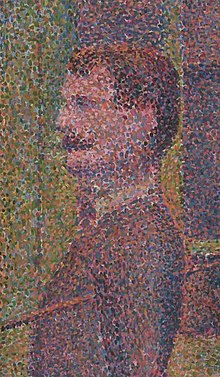
Pixels, a term coined in 1965 and short for picture elements, are the smallest components of a digital image. They can only be one colour, but next to each other in their thousands or millions will blend to make a smooth image full of tones and shapes. The higher the resolution a digital image is, the more pixels are displayed and the smoother the image appears. "Bits" refer to the number of colours a pixel can possibly be. For example, 8-bit colour (ie. 2 to the power of 8) will display 256 colours, 16-bit colour (also called Highcolour; 24-bit colour's known as Truecolour) will display 65,536 colours and so on. The higher the number, the better the picture quality. 
Close up of Seurat's Circus Sideshow

Some artists have created paintings using techniques which almost imitate the aesthetic of a pixelised image. They paint their subjects in a deconstructed fashion, in lots of tiny individual components rather than blending the colours into each other. Georges Seurat, for example, was very fond of using pointilism in his paintings. The singular points of colour in their thousands make his work look grainy and almost pixelised like a digital image with a low resolution. 


Circus Sideshow by Georges Seurat (1889)

While Seurat wasn't aware of the similarity between his work and the pixels of a modern digital image, there are quite a few artists today who deliberately emulate the pixelated aesthetic in their work. 

Chuck Close is one such artist. While he is capable of creating photorealistic images, he chooses to break his images down into hundreds of small componentes. Within each square he uses four or five colours eventually accomplishing a vibrant and unusual aesthetic in his pictures. The over effect makes me think of looking at a person through patterned glass or through the surface of disturbed water. It makes his portraits more interesting to look at by creating a sense of mystery or censorship around the subjects. It piques the viewer's interest in the person being slightly hidden from view by Close's unique style of painting.

John Hinde and Martin Parr


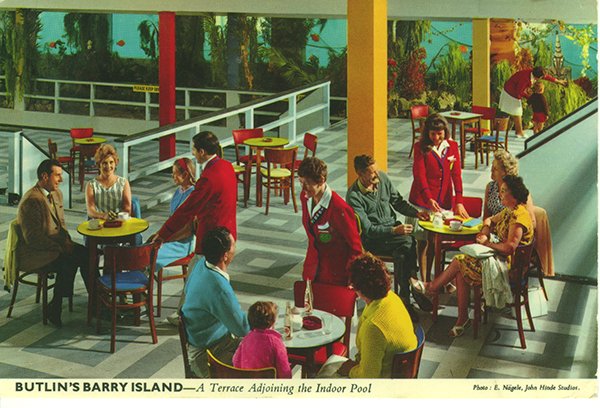
John Hinde was an English photographer, probably most famous for his iconagraphic postcards, particularly of the Butlin's Holiday Camps. He was most active in the 60s, having established his own photography comapany, John Hinde Ltd, and became known for his photographs of the Irish landscape around Dublin. At the time, most postcards were printed in black and white as it was thought this better captured the romantic landscape of Ireland. Hinde, however, favoured colour photos and wanted to capture the vibrancy of the Irish countryside. He would plan his photographs meticulously, often adding things to the scenery or hiding them with rhododendron bushes in order to get the ideal composition. He would spend entire days setting up a photograph to his liking. As well as painstakingly planning a photograph, Hinde would edit the colours in the image to enhance the energy of a scene. This is evident in most of his photographs; the colours seem to burst out at the viewer, forcing their attention to the activity in the scenery. The postcard above, for example, "Butlin's Barry Island", highlights the postive interaction between the staff and holiday-makers with his use of brightly coloured clothing and the close proximity of the subjects.
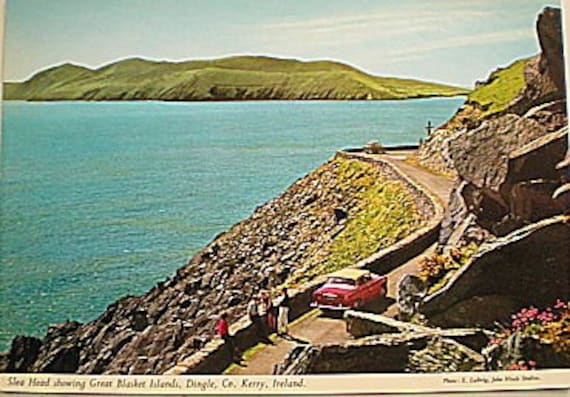
The two postcards above, both taken in Ireland, to me, have a wonderfully tacky fifties/sixties look to them because of the enhanced colours and calculated composition. Hinde had a strict formula when it came to composing a photograph which makes his work easily recognisable. Nowadays photographers generally like to make their photographs looks more spontaneous and open; there aren't as many conventions and rules to follow. However, many artists and photographers have been inspired by Hinde's iconic work.

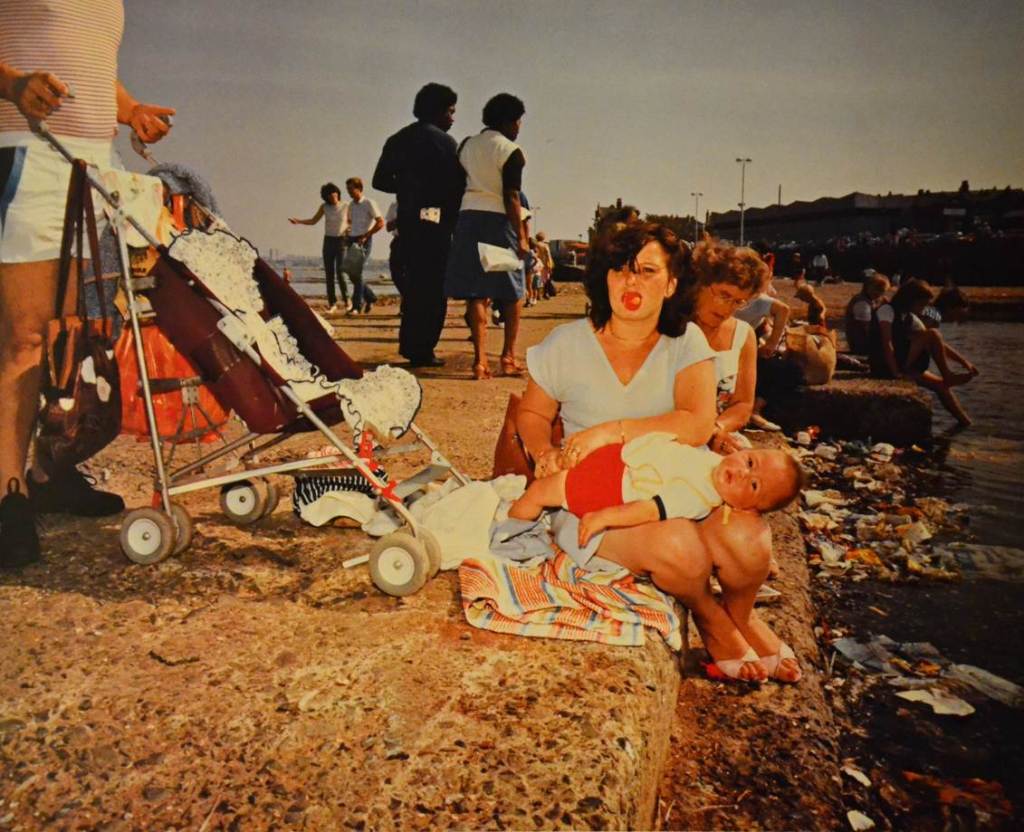
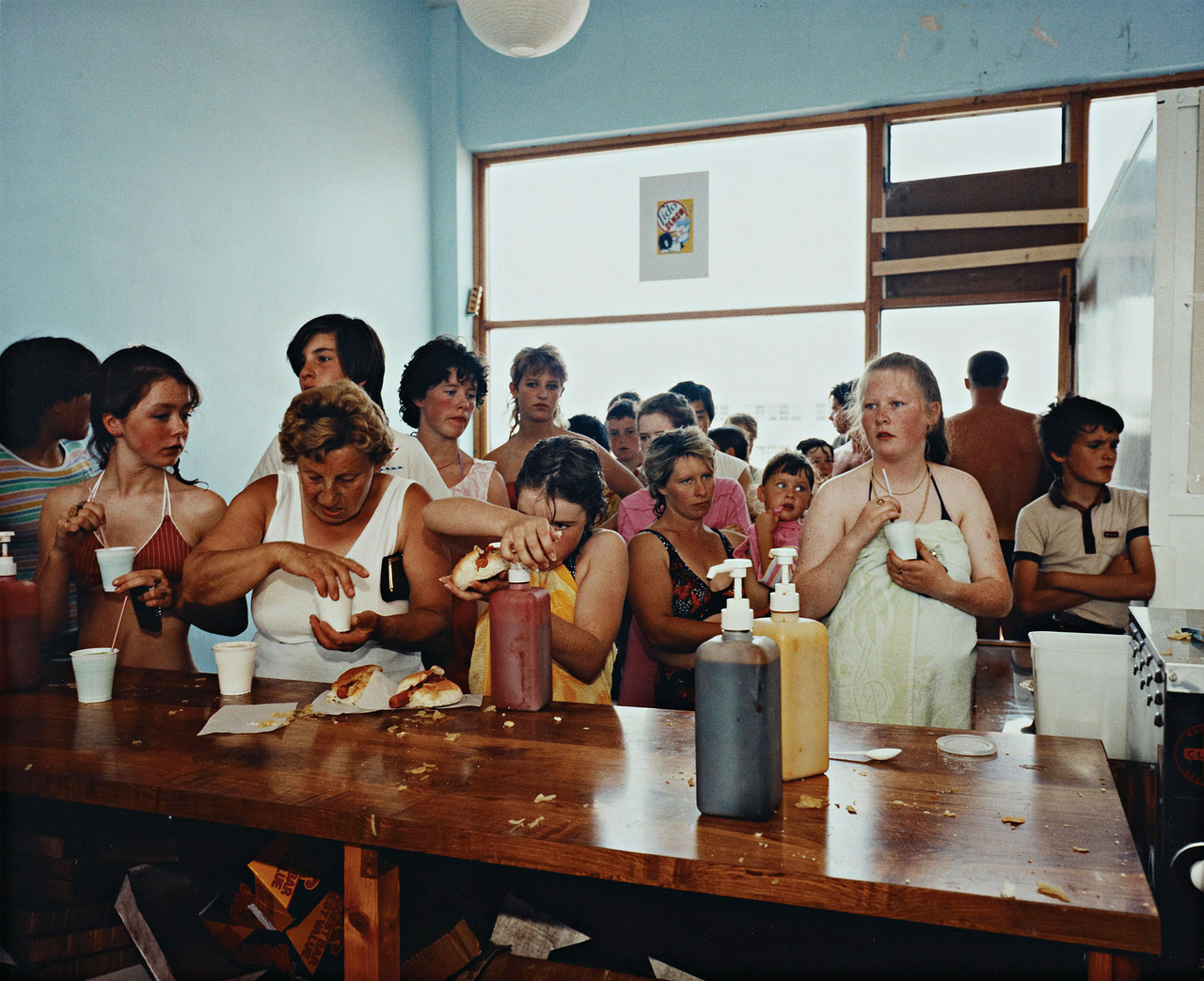
One of these photographers is Martin Parr whose photographs exposing the tacky-ness of British culture have the same empahisis on the colour and activity in a scene.

This photograph is one of a collection published in 1986 titles Last Resort: Photographs of New Brighton. The collection is full of photos documenting British holiday-makersmaking the most of the English summer. It reveals the awfully tacky side British culture and its desperate bid to take advantage of the short summers we have. As soon as the sun comes out people will want to sunbathe, take their children to parks and beaches and wear as little clothing as decently possible. Unlike Hinde, Parr doesn't choreograph his photos but takes a documentative approach to photography. It makes his photos feel more intrusive and gritty than Hinde's composed scenes. Parr wanted to document and highlight the habits of ordinary British people. 


When I look at the picture above I can imagine the clammy feeling of being crammed in a badly conditioned diner with irritable parents and hyper children surrounding me. The photograph perfectly captures the situation so that I can empathise with the people inside it. The image is also particularly effective because of the claustrophobic environment with so many people inside; it looks busy and you can sense the impatience of the people queuing towards the back. I also love it because it's so quintissentially British; there's fast food, tea, rosy faces and queueing!